
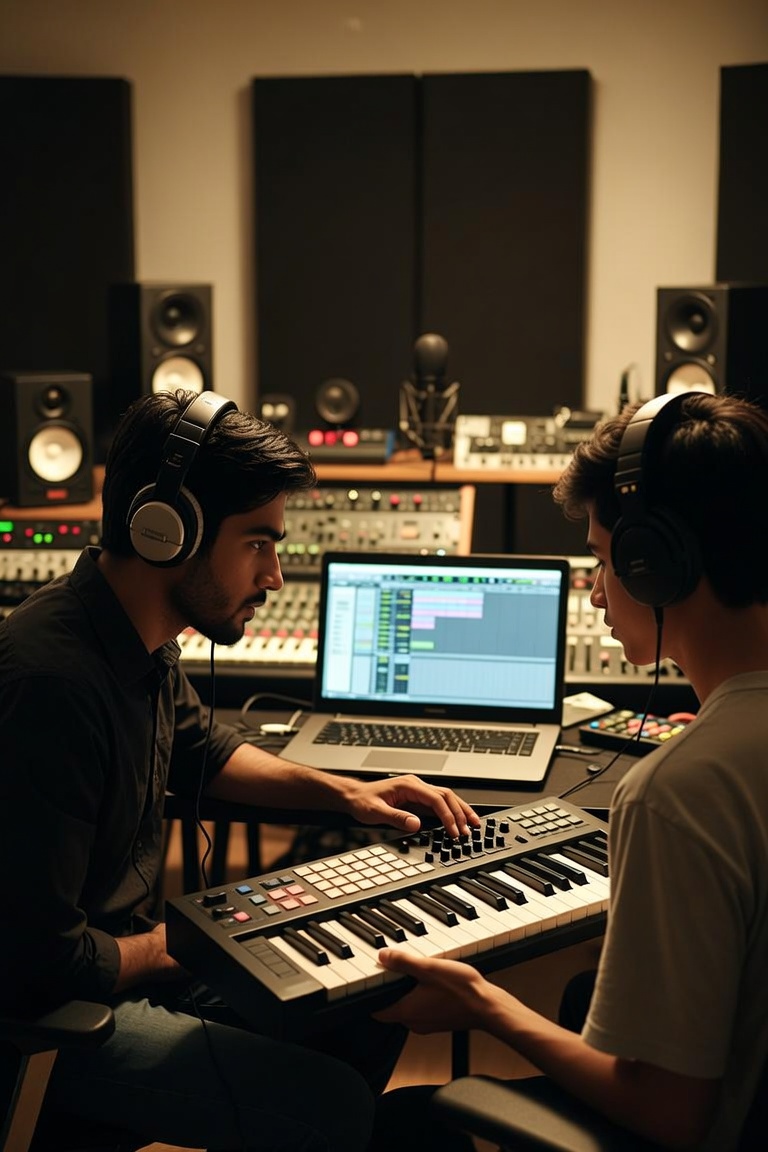
One-on-one music production mentorship is one of the fastest ways to improve as a producer. Tutorials, courses and videos can teach useful techniques, but they cannot listen to your own track and tell you exactly what is working, what is weak and what needs to change.
That is the real power of personalized mentorship. Instead of learning only general information, you receive guidance based on your music, your DAW, your workflow, your goals and your current level. This makes the learning process much more practical and focused.
At The Music Producer School [LINK: https://themusicproducerschool.com/], the goal is to help producers stop guessing and start making better decisions. Whether you are producing EDM, trap, pop, hip hop, cinematic music, vocals or electronic music, personalized feedback can help you understand what is holding your music back.
A structured one-on-one music production mentorship [LINK: https://themusicproducerschool.com/produto/online-music-production-course/] can help you improve your workflow, finish more tracks, understand arrangement, fix mixing problems, choose better sounds and develop a more professional producer mindset.
What Is One-on-One Music Production Mentorship?
One-on-one music production mentorship is personalized training where a producer receives direct guidance from an experienced music producer, audio engineer or mentor. Instead of following a generic path, the learning process is adapted to the student’s needs.
This type of mentorship can include track feedback, DAW workflow, sound selection, arrangement, mixing, mastering, vocal production, beat making, release preparation and creative direction.
The biggest difference between mentorship and random tutorials is feedback. A tutorial teaches a technique. A mentor shows how that technique applies to your own music.
For example, a video can explain EQ, but a mentor can listen to your track and tell you why the vocal sounds muddy. A tutorial can show how to build an EDM drop, but a mentor can explain why your drop does not feel powerful yet. A course can teach arrangement, but a mentor can show exactly where your track loses energy.
This type of direct feedback helps producers grow faster because it focuses on real problems.
Why Personalized Feedback Matters
Many producers get stuck because they cannot hear their own mistakes clearly. This is normal. When you spend hours inside the same project, your ears get used to the problems. You may not notice that the bass is too loud, the drums are weak, the vocal is buried or the arrangement feels repetitive.
Personalized feedback gives you a new perspective. A mentor can identify problems that you may have missed and explain how to fix them.
Feedback is especially important in music production because every track is different. A technique that works in one song may not work in another. A vocal chain that sounds great on one singer may sound harsh on another. A mastering setting that helps one mix may destroy another.
One-on-one mentorship helps students understand the reason behind each decision. Instead of copying presets, you learn how to listen and make choices with intention.
That is one of the most valuable skills a producer can develop.
The Problem With Learning Only From Random Tutorials
There are thousands of music production tutorials online. Some are great, but many teach isolated tricks without explaining the full process.
One video may show a compressor setting. Another may show a bass preset. Another may explain how to master a track. But if you do not understand how these pieces connect, you can still feel lost.
Music production is not a collection of random tricks. It is a complete workflow. Sound selection affects arrangement. Arrangement affects mixing. Mixing affects mastering. Recording quality affects vocal production. Low end affects the entire track.
A producer may watch hundreds of tutorials and still struggle to finish music because there is no clear direction.
A complete music production course [LINK: https://themusicproducerschool.com/courses/] gives structure, but one-on-one mentorship goes even deeper because it applies that structure directly to your own projects.
This is why mentorship is so powerful. It connects knowledge with action.
Who Is Music Production Mentorship For?
Music production mentorship is useful for many types of producers.
Beginners can use mentorship to avoid confusion and build a strong foundation from the start. Instead of wasting months jumping between random videos, beginners can learn the correct order: DAW basics, rhythm, sound selection, arrangement, recording, editing, mixing and exporting.
Intermediate producers can use mentorship to break through plateaus. Many intermediate producers already know how to create loops or basic songs, but they struggle to make their music sound professional. They may need help with arrangement, mixing, low end, vocal production, sound design or finishing tracks.
Advanced producers can also benefit from mentorship. At a higher level, the difference is often in details: better transitions, stronger mix decisions, more emotional arrangement, cleaner masters, faster workflow and more refined creative direction.
Artists can also use mentorship to learn how to produce their own music. Beatmakers can improve their drums, 808s and arrangements. DJs can learn how to create original tracks. Home studio owners can learn how to record and mix better.
Mentorship is not only for one type of student. It is for anyone who wants direct, personalized improvement.
Improve Your Workflow
Workflow is one of the most important parts of music production. A producer with a strong workflow can move from idea to finished track with more confidence. A producer with a weak workflow may start many projects and finish very few.
One-on-one mentorship helps identify where your workflow is breaking down. Maybe you spend too much time choosing sounds. Maybe you create good loops but cannot arrange full songs. Maybe you overthink mixing. Maybe your sessions are disorganized. Maybe you do not know when a track is finished.
A mentor can help you create a better process. This may include organizing your DAW sessions, building templates, creating a better folder structure, choosing sounds faster, using reference tracks and separating the production stage from the mixing stage.
Good workflow does not remove creativity. It protects creativity. When the technical process is organized, the producer has more energy to focus on music.
Finish More Tracks
One of the most common problems among producers is having too many unfinished projects. They start ideas, build loops, add sounds and then move on before finishing.
This happens for many reasons. Sometimes the arrangement feels difficult. Sometimes the mix does not sound good. Sometimes the producer loses confidence. Sometimes the track has no clear direction.
Finishing music is a skill. It requires decisions. You need to know when to add more elements, when to remove sounds, when to move to mixing and when to stop changing the track.
A one-on-one mentor can help you finish more music by showing what each project needs. Some tracks need better arrangement. Some need stronger drums. Some need fewer elements. Some need more movement. Some need a better mix.
The goal is not perfection. The goal is progress. Every finished track teaches you something. A producer who finishes music consistently improves faster than a producer who only starts ideas.
Arrangement Feedback
Arrangement is one of the biggest areas where producers need feedback. A track can have great sounds and still feel boring if the arrangement does not create movement.
Arrangement controls energy. It tells the listener when to expect something, when to relax, when to feel tension and when to feel impact.
In EDM, arrangement may involve intros, buildups, drops, breakdowns and transitions. In trap and hip hop, arrangement may involve hooks, verses, beat changes and space for vocals. In pop, arrangement may involve verse, pre-chorus, chorus, bridge and final chorus. In soundtrack production, arrangement may follow emotion and picture.
A mentor can listen to your track and identify where the arrangement loses energy. Maybe the intro is too long. Maybe the drop arrives too early. Maybe the chorus does not feel bigger than the verse. Maybe the second half of the track needs variation.
These details are hard to judge alone. Personalized arrangement feedback can completely change the quality of a production.
Mixing Feedback
Mixing is another area where one-on-one mentorship can make a major difference. Many producers know the names of mixing tools, but they do not always know how to use them in context.
A mentor can listen to your mix and identify specific problems. The kick may be too loud. The bass may be muddy. The vocal may need presence. The drums may lack punch. The reverb may be covering the mix. The master may be too compressed.
This type of feedback is much more useful than generic advice because it is based on your actual track.
Mixing feedback can include volume balance, EQ, compression, reverb, delay, stereo image, automation, gain staging and reference comparison. The goal is to help the producer understand what the mix needs and why.
A strong mix does not come from adding more plugins. It comes from better listening and better decisions.
For more articles about mixing, mastering, DAWs and production workflow, visit the music production blog [LINK: https://themusicproducerschool.com/blog/].
Sound Selection and Production Direction
Sound selection is one of the fastest ways to improve a production. The right sounds can make a simple idea feel professional. The wrong sounds can make a complex idea feel weak.
A mentor can help identify whether your sounds are supporting the track. Maybe the kick does not match the bass. Maybe the synth is too thin. Maybe the snare does not cut through. Maybe the melody sound does not fit the genre. Maybe the vocal effect is distracting.
Sound selection is not only technical. It is creative direction. It helps define the identity of the track.
This is especially important in EDM, trap, hip hop, pop and electronic music, where sound choice can define the entire production.
Sample packs and producer tools [LINK: https://themusicproducerschool.com/shop/] can help speed up the creative process, but the producer still needs to know how to choose, edit and arrange those sounds with intention.
DAW Guidance
Different producers use different DAWs. Some work in Ableton Live. Others use Logic Pro, FL Studio, Pro Tools, Studio One or Fender Studio Pro.
One-on-one music production mentorship can help students understand their DAW in a practical way. The goal is not to memorize every feature. The goal is to learn the tools that matter for your music.
Ableton Live users may need help with Session View, Arrangement View, warping, automation, racks, sidechain and electronic music workflow. Logic Pro users may need help with recording, MIDI, arrangement, editing and mixing. FL Studio users may need help with pattern workflow, 808s, drums and arrangement. Pro Tools users may focus more on recording, editing and mixing.
For producers focused on electronic music, the Ableton Live course [LINK: https://themusicproducerschool.com/produto/ableton-live-12-edm-course/] can be a strong path.
The DAW is only a tool. Mentorship helps you use that tool with purpose.
Mentorship for EDM Producers
EDM producers can benefit a lot from mentorship because electronic music depends heavily on energy, sound design, arrangement and mix control.
A mentor can help with drops, buildups, transitions, basslines, drum grooves, automation, synth layers and low-end balance. They can also help identify why a drop does not hit hard enough or why a buildup does not create enough tension.
EDM production is not only about loudness. It is about contrast. The drop feels powerful because the arrangement prepares the listener for that moment. The breakdown feels emotional because it creates space. The transition works because it connects sections smoothly.
Personalized feedback helps EDM producers understand these details faster.
Mentorship for Beatmakers
Beatmakers can use mentorship to improve drums, 808s, melodies, arrangements and mixing.
A mentor can listen to a beat and explain why the 808 is not working, why the snare feels weak, why the hi-hats sound robotic or why the melody is too crowded for vocals.
This is especially useful for trap, hip hop, drill, pop and R&B production. Beatmakers often need to leave space for artists. A beat may sound impressive alone but become too busy once vocals are added.
A mentor can help producers create beats that hit hard while still leaving room for the artist.
Mentorship for Vocal Producers
Vocal production is one of the most detailed parts of music production. Recording, editing, comping, tuning, timing, EQ, compression, de-essing, reverb and delay all affect the final result.
A mentor can help producers understand why a vocal sounds amateur and what needs to change. Maybe the recording level is wrong. Maybe the room has too many reflections. Maybe the tuning is too strong. Maybe the vocal needs more compression. Maybe the effects are pushing it too far back.
Vocal feedback is extremely valuable because the voice is often the center of the song.
A strong vocal production workflow can make a track feel much more professional.
Why One-on-One Mentorship Saves Time
Learning alone can be slow. You may spend months trying to solve a problem that an experienced mentor can identify in minutes.
This does not mean mentorship replaces practice. You still need to create music, make mistakes and develop your ears. But mentorship can guide that practice in the right direction.
Instead of wasting time on the wrong problems, you focus on what actually matters. If your track needs arrangement work, you stop wasting hours on mastering. If your mix needs volume balance, you stop adding random plugins. If your sound selection is weak, you fix the source instead of overprocessing.
This saves time and helps you improve faster.
Online Mentorship From Your Own Studio
Online mentorship is powerful because you can learn from your own setup. You can open your own DAW, use your own tracks and apply feedback directly to your own projects.
This makes the learning process practical. You are not only watching someone else work. You are improving your own music.
Online mentorship also works well for home studio producers. You can get feedback on your recording setup, monitoring, workflow, DAW organization and production process.
A strong online music production course [LINK: https://themusicproducerschool.com/produto/online-music-production-course/] combined with personalized guidance can help students build both foundation and confidence.
Is One-on-One Music Production Mentorship Worth It?
Yes, one-on-one music production mentorship is worth it if you want focused improvement. It is especially valuable if you feel stuck, confused or unsure why your music does not sound professional yet.
Mentorship helps you understand your weaknesses and build a plan to improve them. It gives you direct feedback, practical direction and a clearer path.
Free tutorials can teach techniques. A mentor helps you apply those techniques to your own music.
For serious producers, this can be one of the smartest investments in their development.
Learn With a Personalized Producer Workflow
At The Music Producer School [LINK: https://themusicproducerschool.com/], mentorship is built around real music production skills. The focus is on helping students create better tracks, improve their workflow and make stronger decisions.
Whether you are a beginner trying to understand the basics or an intermediate producer trying to reach a more professional sound, personalized training can help you move faster.
If you want to improve your music with direct feedback, better workflow, arrangement guidance, mixing direction and real producer training, one-on-one music production mentorship [LINK: https://themusicproducerschool.com/produto/online-music-production-course/] can help you take the next step.
And if you are not sure which course or mentorship path fits your goals, you can contact The Music Producer School [LINK: https://themusicproducerschool.com/contact/] and discover the best option for your music production journey.