
Music production for beginners can feel exciting and confusing at the same time. You want to create songs, beats, remixes or soundtracks, but there are so many tools, plugins, DAWs, tutorials and opinions that it becomes hard to know where to start.
Many beginners make the same mistake: they try to learn everything at once. They download too many plugins, watch random videos, buy sample packs, change DAWs, copy presets and still feel stuck when it is time to finish a complete track.
The truth is that music production becomes much easier when you follow a clear path. You do not need to know everything on day one. You need to understand the foundation: your DAW, rhythm, sound selection, arrangement, recording, editing, mixing and exporting.
At The Music Producer School [LINK: https://themusicproducerschool.com/], the goal is to help new producers learn music production with structure. A beginner does not need confusion. A beginner needs direction, practice and a workflow that makes sense.
A complete online music production course [LINK: https://themusicproducerschool.com/produto/online-music-production-course/] can help you move from random ideas to finished tracks with more confidence.
What Is Music Production?
Music production is the process of creating a song or track from an idea to a finished audio file. It can include songwriting, beat making, recording, arranging, editing, sound design, mixing, mastering and exporting.
A music producer may create drums, melodies, basslines, vocals, effects, harmonies and full arrangements. In modern music, many producers work inside a computer using a DAW, which means Digital Audio Workstation.
Music production can be used for many styles, including EDM, trap, hip hop, pop, rock, R&B, cinematic music, game music, lo-fi, afro house, reggae and more.
The producer’s job is not only to press buttons. The producer makes decisions. What sound should enter? What should be removed? Where should the chorus happen? Should the drums be stronger? Is the vocal clear enough? Does the track feel finished?
Music production is the art of turning ideas into complete music.
What Do Beginners Need to Start Producing Music?
A beginner does not need a huge studio to start producing music. You can begin with a simple setup and improve over time.
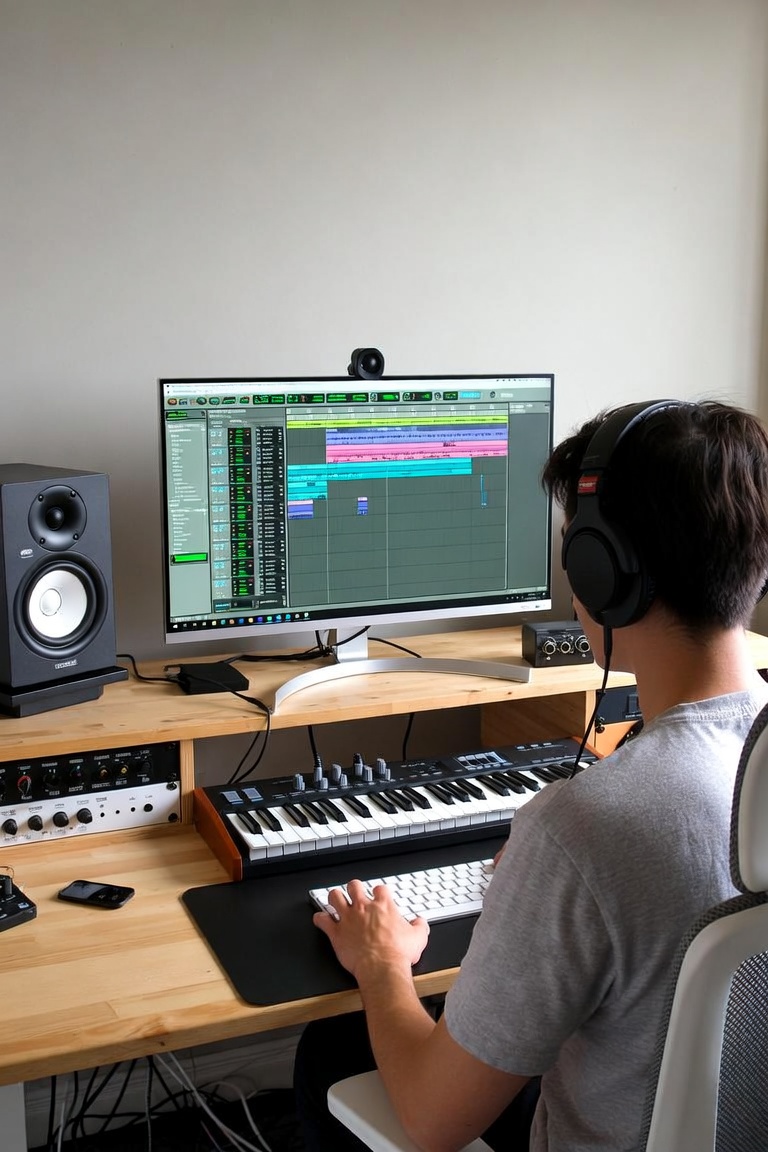
The basic setup usually includes a computer, a DAW, headphones or studio monitors, and maybe a MIDI keyboard. If you want to record vocals or instruments, you will also need an audio interface and a microphone.
The most important thing is not having the most expensive gear. The most important thing is learning how to use what you have.
Many beginners spend too much time researching equipment and not enough time making music. Gear matters, but skill matters more. A great producer can create strong music with simple tools because they understand rhythm, arrangement, sound selection and mixing.
Start simple. Learn the basics. Finish tracks. Then upgrade your setup when you understand what you actually need.
Choosing Your First DAW
Your DAW is the software where you create music. Popular DAWs include Ableton Live, Logic Pro, FL Studio, Pro Tools, Studio One and Fender Studio Pro.
Each DAW has strengths. Ableton Live is great for electronic music, EDM, loops, sound design and live performance. Logic Pro is excellent for recording, songwriting, MIDI production and mixing. FL Studio is popular for beat making, trap and hip hop. Pro Tools is strong for recording, editing and professional studio workflows. Studio One and Fender Studio Pro can also support modern production workflows.
The best DAW for beginners is the one you can learn consistently. Do not waste months switching between programs. Choose one and focus on learning it deeply.
If you want to produce electronic music, EDM or beats in Ableton, the Ableton Live course [LINK: https://themusicproducerschool.com/produto/ableton-live-12-edm-course/] can help you build a faster workflow.
If you want a wider foundation in production, recording, mixing and mastering, the online music production course [LINK: https://themusicproducerschool.com/produto/online-music-production-course/] is a strong place to start.
Learn the Basic Parts of a Song
Before you start adding plugins, it is important to understand the basic parts of a song. Most tracks are built with sections.
Common sections include intro, verse, pre-chorus, chorus, bridge, drop, breakdown and outro. Not every song uses all of these, but every track needs some kind of structure.
The structure depends on the genre. EDM often uses intro, buildup, drop, breakdown and outro. Trap and hip hop often use intro, hook, verse, hook and outro. Pop often uses verse, pre-chorus, chorus and bridge. Soundtrack music may follow the emotion of a scene instead of a traditional song structure.
Beginners often create a good loop but never turn it into a full track. Learning song structure helps solve this problem. Once you understand sections, you can move beyond the loop and create a complete arrangement.
Start With Drums and Rhythm
Rhythm is one of the foundations of music production. Drums create movement, energy and groove.
In many genres, the drum pattern is the first thing that makes a track feel alive. A kick, snare, clap, hi-hat and percussion pattern can create the entire feel of the song.
Beginners should start by learning simple drum patterns. Do not worry about making everything complex. A simple groove with the right sounds can be more effective than a complicated pattern that feels messy.
Velocity, timing and spacing are important. Not every drum hit should have the same strength. Small changes in velocity can make a pattern feel more natural. Pauses are also powerful. A groove needs space.
In trap, hi-hats, snares and 808s are essential. In EDM, the kick and percussion drive the energy. In pop, drums need to support the vocal. In cinematic music, percussion may create tension or impact.
Learning rhythm makes every production stronger.
Understand Bass and Low End
Bass is one of the most important parts of music production. It gives weight, movement and power to the track.
For beginners, bass can be confusing because low frequencies are hard to hear accurately, especially in untreated rooms or cheap headphones. But understanding bass is essential.
The bass should usually work with the kick. In EDM, trap, hip hop and pop, the kick and bass relationship can make or break the mix. If they fight each other, the track sounds muddy. If they work together, the track feels powerful.
A bassline should support the rhythm and harmony. It does not always need to be complicated. Sometimes a simple bassline is the best choice.
Beginners should focus on choosing the right bass sound, keeping the low end clean and making sure the bass supports the song instead of covering everything.
Learn Chords and Melodies
You do not need to be a music theory expert to start producing music, but understanding basic chords and melodies helps a lot.
Chords create emotion. A minor chord progression can feel sad, dark or serious. A major progression can feel brighter or more hopeful. Different chord movements create different emotions.
Melodies give the track identity. A strong melody can make a song memorable. It can be played by a vocal, synth, piano, guitar, flute, bell, string or any other instrument.
Beginners should start with simple ideas. A melody does not need to have many notes to be powerful. In many songs, the most memorable melodies are simple, clear and repeated with intention.
If you are producing beats, melodies should leave space for vocals. If you are producing EDM, melodies can become hooks or drops. If you are producing cinematic music, melodies can become themes.
The goal is not to write complicated music. The goal is to create emotion.
Sound Selection Matters More Than Plugins
Sound selection is one of the fastest ways to improve your music. Choosing the right sounds can make a simple production feel professional. Choosing weak sounds can make even a good idea feel amateur.
Many beginners try to fix bad sounds with plugins. They add EQ, compression, saturation, reverb and effects, but the track still does not sound right. The problem is often the original sound.
A good kick should fit the style. A snare should have the right character. A synth should support the mood. A vocal sample should match the key and rhythm. A bass should work with the kick.
Sample packs and producer tools [LINK: https://themusicproducerschool.com/shop/] can help beginners find better raw material, but the producer still needs to choose sounds with taste.
Before mixing, ask yourself: do these sounds already work together? If the answer is yes, the rest of the process becomes easier.
Learn Arrangement Early
Arrangement is the skill that turns an idea into a full song. This is one of the most important things beginners need to learn.
A loop can sound good for eight bars, but a full track needs movement. The listener needs changes, contrast and development.
Arrangement is about deciding when elements enter and leave. The drums may start simple, then become bigger. The bass may enter after the intro. The chorus may add new layers. The second verse may remove elements to create space. The bridge may change the emotion.
In EDM, arrangement creates tension and release. In trap, arrangement leaves space for the artist. In pop, arrangement supports the vocal hook. In soundtrack music, arrangement follows emotion and picture.
If you want to finish music, you need to practice arrangement. Do not stay trapped in loops forever.
Recording Audio at Home
Many beginners want to record vocals, guitars, keyboards or other instruments at home. This is possible with a simple home studio setup.
To record audio, you usually need a microphone, an audio interface and a quiet space. The quality of the recording depends on the microphone, room, performance, gain level and recording technique.
A clean recording is easier to mix. If the recording is noisy, distorted or full of room reflections, mixing becomes harder.
For vocals, use a pop filter, control background noise and avoid recording too loud. Keep a consistent distance from the microphone. Make sure the singer can hear the instrumental clearly in the headphones.
Recording is not only technical. A great performance matters more than a perfect plugin chain. The emotion needs to be captured first.
MIDI and Virtual Instruments
MIDI allows you to create music using virtual instruments inside your DAW. You can program drums, bass, piano, synths, strings, pads and many other sounds.
A MIDI keyboard can help, but you can also write MIDI notes with your mouse. Beginners often start by drawing notes in the piano roll.
Virtual instruments are powerful because they allow you to create complete productions without recording live instruments. You can produce EDM, trap, pop, cinematic music and many other styles using software instruments.
The key is learning how to make MIDI feel musical. Velocity, timing, note length and expression matter. If every note is the same volume and perfectly on the grid, the part may feel robotic. Sometimes that is useful, but often small variations make the music feel more alive.
Basic Audio Editing
Editing is part of music production. It helps clean and organize the performance.
Audio editing can include cutting unwanted noise, adjusting timing, creating fades, removing clicks, comping vocal takes and aligning parts with the rhythm.
Good editing should feel invisible. The listener should not notice the edits. They should only feel that the performance sounds clean and connected.
Beginners should learn basic editing early because messy audio can create problems later in the mix.
If you record vocals, editing becomes even more important. You may need to choose the best takes, clean breaths, fix timing and prepare the vocal before mixing.
A clean session makes the entire production easier.
Mixing for Beginners
Mixing is the process of balancing all the elements in your track. It includes volume, EQ, compression, reverb, delay, stereo image and automation.
For beginners, the first rule is simple: start with volume. Before adding plugins, make sure the elements are at the right level.
The kick, bass, drums, melody, vocals and effects need to work together. If the balance is wrong, plugins will not fix everything.
After volume, you can use EQ to create space. Compression can control dynamics. Reverb and delay can create depth. Automation can create movement.
Do not try to make everything loud. Mixing is about balance. The most important elements should be clear, and the less important elements should support them.
A beginner mix does not need to be perfect. It needs to be clean enough to understand the song.
Mastering for Beginners
Mastering is the final stage before release. It prepares the track for listening on different systems.
Many beginners think mastering is only about loudness. Loudness is part of it, but mastering is also about balance, translation and final polish.
A good master cannot fix a bad mix. If the mix is muddy, harsh or unbalanced, mastering will only make those problems more obvious. That is why the mix should be as strong as possible before mastering.
Beginners should keep mastering simple. Do not over-compress or push limiters too hard. The goal is to make the track feel finished without destroying the dynamics.
As you improve, you can learn more advanced mastering techniques. But in the beginning, focus on finishing music and comparing your results with reference tracks.
Use Reference Tracks
Reference tracks are professional songs that you compare with your own production. This is one of the best learning tools for beginners.
Choose songs in the same style as your track. Compare volume balance, drums, bass, vocal level, brightness, low end, arrangement and energy.
The goal is not to copy. The goal is to understand the standard of the genre.
A reference track can show you if your mix is too muddy, too bright, too quiet, too empty or too crowded. It can also help you understand arrangement decisions.
Critical listening is a skill. The more you compare and practice, the better your ears become.
Finish Your First Tracks
The most important advice for beginners is this: finish music.
Your first tracks may not sound professional. That is normal. Every producer starts somewhere. The goal is not perfection. The goal is progress.
Finishing a track teaches you the full process. You learn how to start, arrange, edit, mix, master and export. If you only create loops, you only practice the beginning.
A producer who finishes ten imperfect tracks learns more than a producer who spends months trying to perfect one loop.
Finishing builds confidence. It also shows you what you need to improve next.
Common Beginner Mistakes
One common mistake is buying too many plugins too early. Plugins can help, but they do not replace skill.
Another mistake is switching DAWs constantly. Every time you switch, you restart the learning process. Choose one DAW and learn it properly.
Many beginners also mix too early. They spend hours processing sounds before the song is arranged. This can slow down creativity.
Another mistake is adding too many elements. More sounds do not always make a track better. Sometimes fewer sounds create more impact.
The biggest mistake is not finishing music. If you want to improve, finish projects regularly.
How Long Does It Take to Learn Music Production?
Learning music production takes time. You can learn the basics in a few weeks or months, but developing a professional sound takes consistent practice.
The speed depends on how often you practice, how structured your learning is and whether you get feedback.
If you only watch tutorials but do not create music, progress will be slow. If you produce regularly, finish tracks and study with direction, you will improve much faster.
Music production is a long-term skill. The goal is not to learn everything overnight. The goal is to keep improving with every project.
A structured course can save time because it gives you the right order and helps you avoid common mistakes.
Can You Learn Music Production Online?
Yes, you can learn music production online. In fact, online learning can be very effective because you can study from your own studio and apply each lesson directly to your own projects.
The key is choosing a course with structure. Random tutorials can be useful, but they often leave gaps. A complete course helps you understand how everything connects.
Online learning also allows you to repeat lessons, practice at your own pace and build a workflow around your schedule.
At The Music Producer School [LINK: https://themusicproducerschool.com/], students can learn music production online with a practical approach focused on real results.
For more free guides and production articles, visit the music production blog [LINK: https://themusicproducerschool.com/blog/].
Music Production for Different Genres
Music production changes depending on the genre, but the foundation remains the same.
EDM production focuses on drops, buildups, sound design, drums, bass and energy. Trap production focuses on 808s, drums, melodies, bounce and space for vocals. Pop production focuses on songwriting, vocals, arrangement and emotion. Soundtrack production focuses on mood, timing, atmosphere and visual storytelling. Lo-fi production focuses on texture, groove and vibe.
Once you understand the basics, you can apply them to any genre.
The best producers are flexible. They understand the tools and adapt them to the song.
Learn Music Production With Structure
Music production for beginners does not need to be confusing. You do not need to learn everything at once. You need a clear path.
Start with your DAW. Learn rhythm. Choose better sounds. Build simple arrangements. Record clean audio. Practice mixing. Finish songs. Repeat the process.
At The Music Producer School [LINK: https://themusicproducerschool.com/], the focus is on helping students build real production skills with structure and confidence.
If you want to stop feeling lost and start creating complete tracks from home, the online music production course [LINK: https://themusicproducerschool.com/produto/online-music-production-course/] can help you understand the process from the first idea to the final export.
And if you are not sure which course is best for your goals, you can contact The Music Producer School [LINK: https://themusicproducerschool.com/contact/] and discover the best path for your music production journey.