
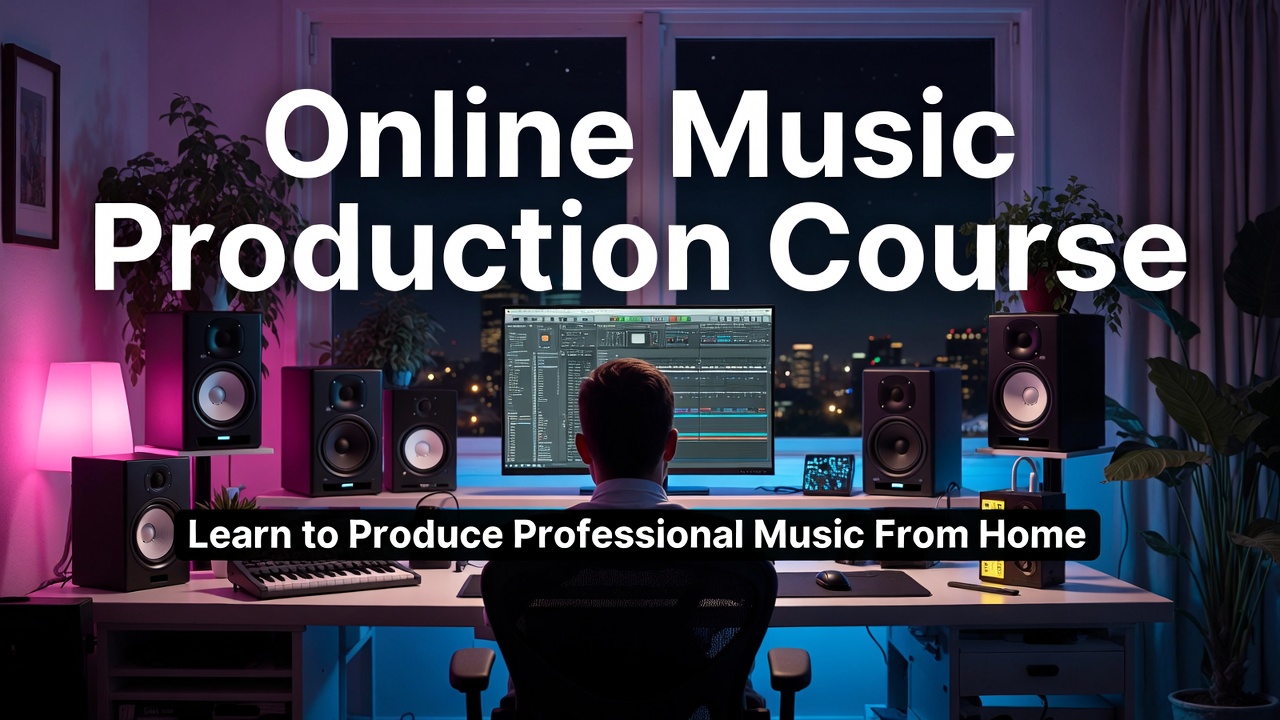
Learning music production from home has never been easier. Today, anyone with a computer, a DAW and a pair of headphones can start creating beats, songs, soundtracks or electronic music. But having access to tools is not the same as knowing how to use them with confidence. This is where an online music production course can make a huge difference.
Many beginners start by watching random tutorials, downloading free plugins, collecting sample packs and copying techniques from different producers. At first, this feels exciting. But after a while, the same problem usually appears: unfinished projects, confusing sessions, weak mixes and no clear direction.
The truth is simple. Music production is not just about learning software. It is about understanding the full creative process from the first idea to the final master. A good course should help you organize your workflow, make better musical decisions and finish tracks that sound more professional.
Why an Online Music Production Course Is Better Than Random Tutorials
Random tutorials can be useful, but they usually teach isolated tricks. One video explains compression. Another one shows a reverb technique. Another one gives you a quick beat-making tip. The problem is that these pieces do not always connect.
A structured online music production course gives you a path. Instead of jumping from one topic to another, you learn step by step. You understand how to start a project, how to build a groove, how to create melodies, how to arrange a full song, how to mix your elements and how to prepare your final track for release.
This structure is important because music production has many layers. If you skip the basics, advanced techniques will not help much. For example, expensive plugins will not fix a weak arrangement. A loud master will not save a muddy mix. A great sample pack will not make a track professional if the producer does not understand rhythm, energy and balance.
What You Should Learn in a Music Production Course
A complete music production course should teach more than one feature inside one program. It should help you understand how professional music is built.
The first step is usually learning your DAW. This could be Ableton Live, Logic Pro, FL Studio, Pro Tools, Studio One, Fender Studio Pro or another modern music production software. The DAW is where you record, edit, arrange, mix and export your music.
After that, you need to understand rhythm and groove. Drums are the foundation of many genres, especially EDM, trap, hip hop, pop and electronic music. Learning how to program kicks, snares, claps, hi-hats and percussion can completely change the energy of your track.
Melody and harmony are also essential. You do not need to become a classical composer to produce music, but you should understand how chords, basslines, hooks and melodies work together. Strong musical ideas make production much easier.
Arrangement is another major part of the process. Many producers create good loops but struggle to turn them into full songs. A course should teach you how to build intros, verses, drops, choruses, breakdowns, transitions and outros in a way that keeps the listener interested.
Then comes mixing. Mixing is where you balance volume, EQ, compression, space, depth and stereo image. A good mix helps every element sit in the right place. It makes the track clearer, more emotional and easier to listen to on different speakers.
Finally, mastering prepares the track for release. Mastering is not just making music louder. It is about final balance, translation, consistency and impact.
Learn Music Production From Home With a Real Workflow
One of the biggest advantages of online learning is flexibility. You can study from your own home studio, repeat lessons, pause when needed and apply each concept directly to your own music.
This is especially useful for producers who already have a busy routine. Instead of depending on a fixed classroom schedule, you can build your skills at your own pace. You can learn a technique, open your DAW, test it immediately and hear the result in your own project.
But flexibility alone is not enough. The most important thing is having a clear workflow. A real producer needs to know what to do when opening a blank session. The goal is to stop guessing and start making decisions with intention.
At The Music Producer School, the focus is not only on tools. The goal is to help students think like producers. That means learning how to choose better sounds, organize sessions, build energy, fix weak parts and finish music with more confidence.
Online Music Production for Different Genres
Music production can be applied to many styles. Some students want to produce EDM. Others want to create trap beats, pop songs, cinematic soundtracks, vocal productions, hip hop instrumentals or electronic music.
The software may change, but the foundation remains the same. Every producer needs workflow, sound selection, arrangement, mixing and finishing skills.
For EDM, the focus may be drops, buildups, transitions, basslines and sound design. For trap, the focus may be drums, 808s, melodies and bounce. For pop, the focus may be vocals, songwriting, arrangement and emotion. For soundtrack production, the focus may be mood, atmosphere, timing and storytelling.
A strong online music production course should help you understand these differences while still giving you a solid foundation that works in any genre.
Why Finishing Music Is the Real Goal
Many producers have hundreds of unfinished projects. They start ideas, get excited for a few hours and then move on to something else. This is one of the biggest problems in music production.
Finishing music is a skill. It requires focus, structure and decision-making. You need to know when to add more elements and when to remove them. You need to know when a section is too repetitive, when a mix is too crowded and when a track is ready to move forward.
A course can help you develop this discipline. Instead of waiting for inspiration, you learn a process. And once you have a process, finishing music becomes much more realistic.
Is an Online Music Production Course Worth It?
If your goal is only to play around with sounds, free tutorials may be enough. But if you want to improve faster, finish better tracks and understand how professional music is created, a structured course is a smart investment.
A good online music production course can save you years of trial and error. It gives you direction, vocabulary, workflow and confidence. More importantly, it helps you understand why something works, not just how to copy a technique.
The best producers are not the ones with the most plugins. They are the ones who make better decisions. They know how to listen, how to organize ideas and how to turn emotion into sound.
If you want to produce music from home and create tracks that sound more complete, professional and release-ready, an online music production course can be the right first step.
The Music Producer School was created for producers who want to learn with structure, improve their sound and build real music production skills. Whether you are a beginner or already producing your own tracks, the right training can help you move from unfinished ideas to finished music.